
Programmatic Advertising Explained: A Beginner-to-Advanced Guide
Digital advertising has evolved rapidly over the past decade, and at the heart of this transformation lies programmatic advertising. Once considered a niche technology, programmatic is now the dominant method for buying and selling digital ads globally.
But what exactly is programmatic advertising? How does it work? And how can marketers—from beginners to advanced practitioners—leverage it effectively?
This comprehensive guide breaks it all down.
What Is Programmatic Advertising?
Programmatic advertising is the automated buying and selling of digital ad inventory using software and algorithms, rather than manual negotiations.
Instead of human insertion orders and back-and-forth emails, programmatic uses real-time systems to:
- Identify the right audience
- Bid on ad impressions
- Deliver ads instantly
All of this happens in milliseconds.
👉 In simple terms:
Programmatic = automation + data + real-time decision-making
Why Programmatic Advertising Matters
Programmatic has become the backbone of modern digital marketing for several reasons:
1. Efficiency
Automation eliminates manual processes, saving time and reducing errors.
2. Precision Targeting
Advertisers can reach specific audiences based on:
- Behavior
- Demographics
- Interests
- Location
3. Real-Time Optimization
Campaigns can be adjusted instantly based on performance.
4. Scale
Programmatic enables brands to reach millions of users across websites, apps, and devices.
The Programmatic Ecosystem (Key Players)
To understand programmatic, you need to know the main components:
1. Demand-Side Platform (DSP)
A DSP is a platform advertisers use to buy ad inventory.
Example: The Trade Desk
DSPs allow marketers to:
- Set budgets
- Define targeting
- Bid on impressions
2. Supply-Side Platform (SSP)
An SSP helps publishers sell their ad inventory.
Example: PubMatic
It connects publishers to multiple buyers to maximize revenue.
3. Ad Exchange
This is the marketplace where buying and selling happen in real time.
Example: Google Ad Exchange
4. Data Management Platform (DMP)
A DMP collects and organizes audience data for targeting.
Example: Oracle BlueKai
5. Ad Server
Ad servers store and deliver ads while tracking performance.
How Programmatic Advertising Works (Step-by-Step)
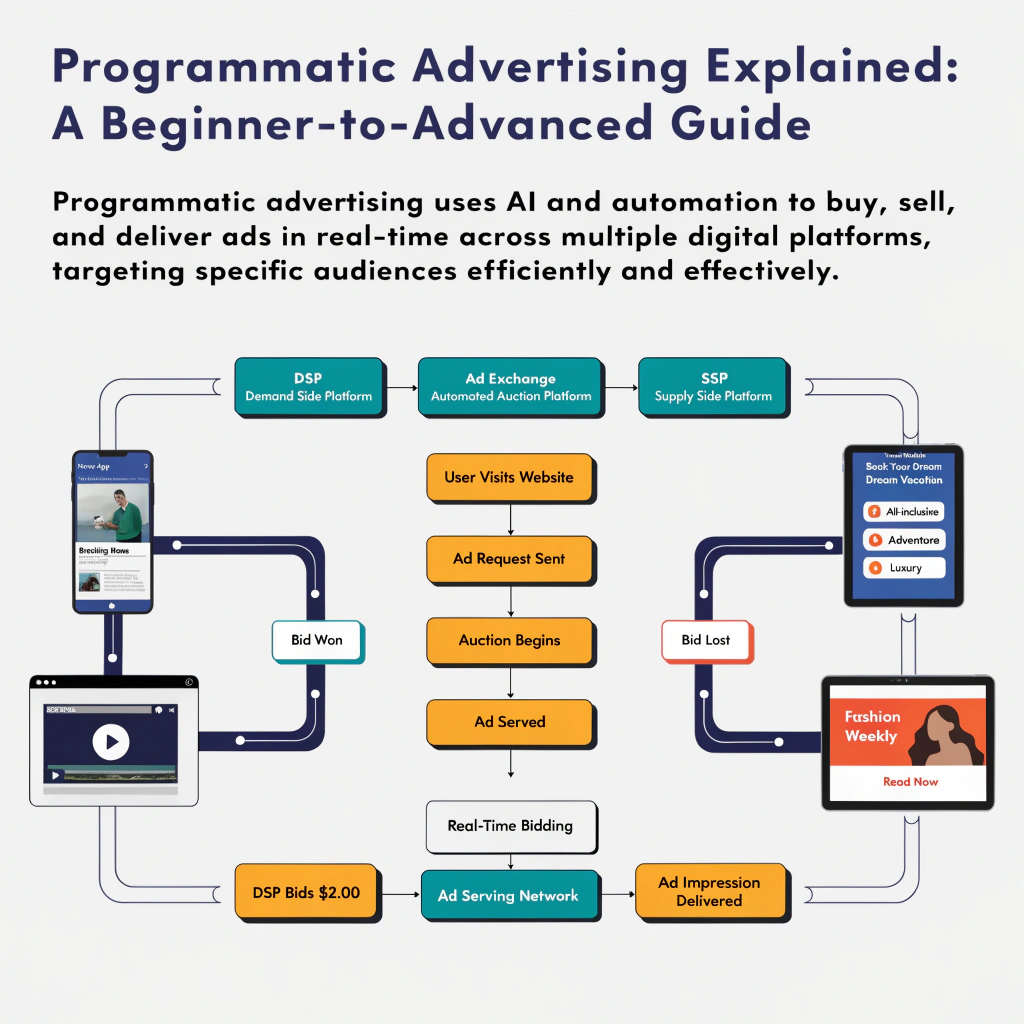
Let’s walk through what happens when a user visits a website:
- A user opens a webpage
- The publisher’s SSP sends a bid request to an ad exchange
- Advertisers (via DSPs) evaluate the user data
- They place bids in real time
- The highest bidder wins
- The ad is displayed instantly
This process is called Real-Time Bidding (RTB) and takes place in under 100 milliseconds.
Types of Programmatic Advertising
Programmatic isn’t just one method—it includes several buying models:
1. Real-Time Bidding (RTB)
Open auction where anyone can bid on impressions.
2. Private Marketplace (PMP)
Invite-only auctions with premium publishers.
3. Programmatic Direct
Advertisers buy inventory directly from publishers at fixed prices.
4. Preferred Deals
Advertisers get priority access before inventory hits open auctions.
Programmatic Channels
Programmatic isn’t limited to display ads. It spans multiple formats:
1. Display Advertising
Banner ads across websites.
2. Video Advertising
In-stream and out-stream video ads.
3. Mobile Advertising
Ads within apps and mobile web.
4. Connected TV (CTV)
Ads on streaming platforms like Roku
5. Digital Out-of-Home (DOOH)
Programmatic ads on billboards and public screens.
Beginner Tips: Getting Started with Programmatic
If you’re new, start with these fundamentals:
1. Define Clear Goals
- Brand awareness
- Lead generation
- Conversions
2. Start with a DSP
Choose a beginner-friendly platform and run small test campaigns.
3. Understand Your Audience
Use basic targeting:
- Location
- Device
- Interests
4. Set a Budget
Start small, optimize, then scale.
5. Monitor Key Metrics
Track:
- Impressions
- Click-through rate (CTR)
- Cost per acquisition (CPA)
Intermediate Strategies
Once you’re comfortable, move to more advanced tactics:
1. Audience Segmentation
Break users into groups based on behavior and intent.
2. Retargeting
Show ads to users who previously interacted with your brand.
3. Frequency Capping
Limit how often users see your ads to avoid fatigue.
4. A/B Testing
Test different creatives, formats, and messages.
5. Contextual Targeting
Target based on content rather than user data.
Advanced Programmatic Techniques
For experienced marketers, programmatic becomes a powerful growth engine:
1. AI & Machine Learning Optimization
Modern DSPs use AI to:
- Predict performance
- Optimize bids
- Allocate budget dynamically
2. First-Party Data Activation
Leverage your own customer data for precise targeting.
3. Lookalike Modeling
Find new users similar to your best customers.
4. Cross-Channel Campaigns
Run unified campaigns across:
- Display
- Video
- CTV
- Mobile
5. Data Clean Rooms
Secure environments for data collaboration without exposing user-level data.
Challenges in Programmatic Advertising
Despite its advantages, programmatic comes with challenges:
1. Ad Fraud
Fake impressions and bot traffic can waste budgets.
Solutions include tools like DoubleVerify
2. Brand Safety
Ads may appear next to inappropriate content.
3. Lack of Transparency
Complex supply chains can make it hard to track costs.
4. Privacy Regulations
Laws like GDPR and CCPA limit data usage.
The Impact of a Cookieless Future
Programmatic advertising is evolving due to declining reliance on third-party cookies.
Key shifts include:
- Greater use of first-party data
- Growth of contextual targeting
- Increased reliance on AI
This means less precise tracking—but more privacy-friendly advertising.
Best Practices for Success
To succeed in programmatic advertising:
✔ Focus on Data Quality
Good data = better targeting and performance
✔ Invest in Creative
Even the best targeting won’t work with poor creatives
✔ Optimize Continuously
Programmatic is not “set and forget”
✔ Diversify Channels
Don’t rely on one platform
✔ Prioritize Transparency
Work with trusted partners
The Future of Programmatic Advertising
Looking ahead, programmatic will be shaped by:
- AI-driven automation
- Privacy-first technologies
- Growth of CTV and retail media
- Increased use of first-party data
Programmatic is no longer just a tool—it’s the foundation of digital advertising.
Programmatic advertising has transformed how brands connect with audiences. From real-time bidding to AI-powered optimization, it offers unmatched efficiency, scale, and precision.
For beginners, it may seem complex—but once you understand the ecosystem and workflows, it becomes an incredibly powerful tool.
For advanced marketers, the opportunity lies in leveraging data, automation, and strategy to drive measurable results. Programmatic isn’t just the future—it’s already the present. The key is learning how to use it effectively at every level.