
Marketing Technology (MarTech) Market Worth USD 3.28 Trillion by 2035 Driven by AI, Agile Marketing, and Privacy-First Personalization
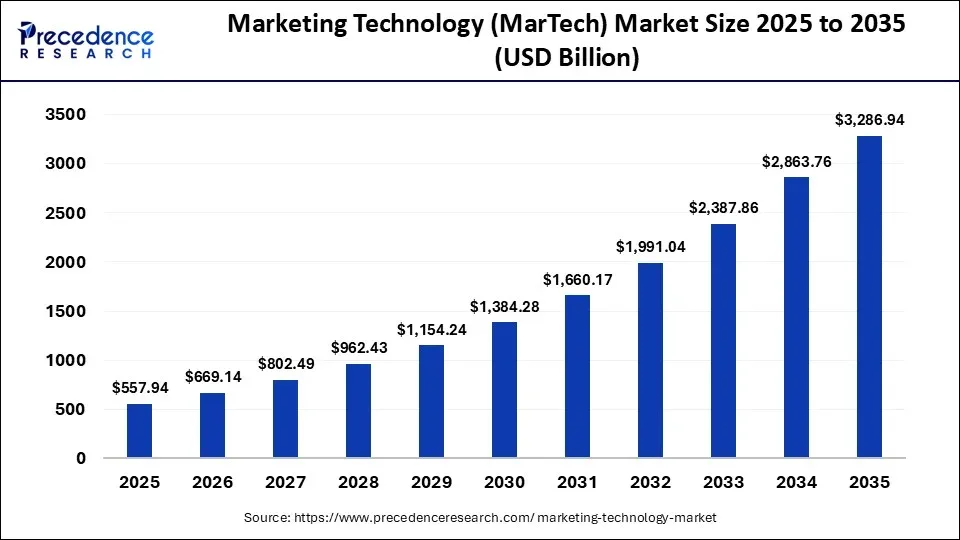
The global marketing technology (MarTech) market size will grow from USD 669.14 billion in 2026 to nearly USD 3.28 trillion by 2035, expanding at a CAGR of 19.40% from 2026 to 2035. Marketers use marketing technology tools to inspire, retain, and engage consumers, driving the global marketing technology (MarTech) market.
Ottawa, Feb. 25, 2026 (GLOBE NEWSWIRE) — According to Precedence Research, the global marketing technology market size was calculated at USD 557.94 billion in 2025 and is predicted to be worth USD 3,286.94 billion by 2035, growing at a strong CAGR of 19.40% from 2026 to 2035.
The market growth is being fueled by increasing adoption of digital marketing platforms, rising demand for data-driven customer engagement strategies, and the growing integration of automation tools across industries.
Marketing Technology (MarTech) Market Key Highlights
- North America led the global market, accounting for the highest share of 33% in 2025.
- Asia Pacific is expected to experience the fastest growth in the coming years.
- By product, social media tools dominated with a 22% market share in 2025.
- Sales enablement tools are projected to witness strong growth over the forecast period.
- By type, the digital marketing segment held the largest share in 2025.
- The offline marketing segment is anticipated to grow at a notable CAGR from 2026 to 2035.
- By application, the healthcare sector accounted for the largest market share in 2025.
- The retail & e-commerce segment is expected to expand rapidly during the forecast period.
What is Marketing Technology (MarTech)?
MarTech refers to the software tools marketers utilize to develop, automate, monitor, and enhance their marketing initiatives. It involves leveraging technology such as software applications or machine learning to improve campaigns and strategies. MarTech encompasses automating marketing processes, applying data analytics for performance tracking, and continuously optimizing results.